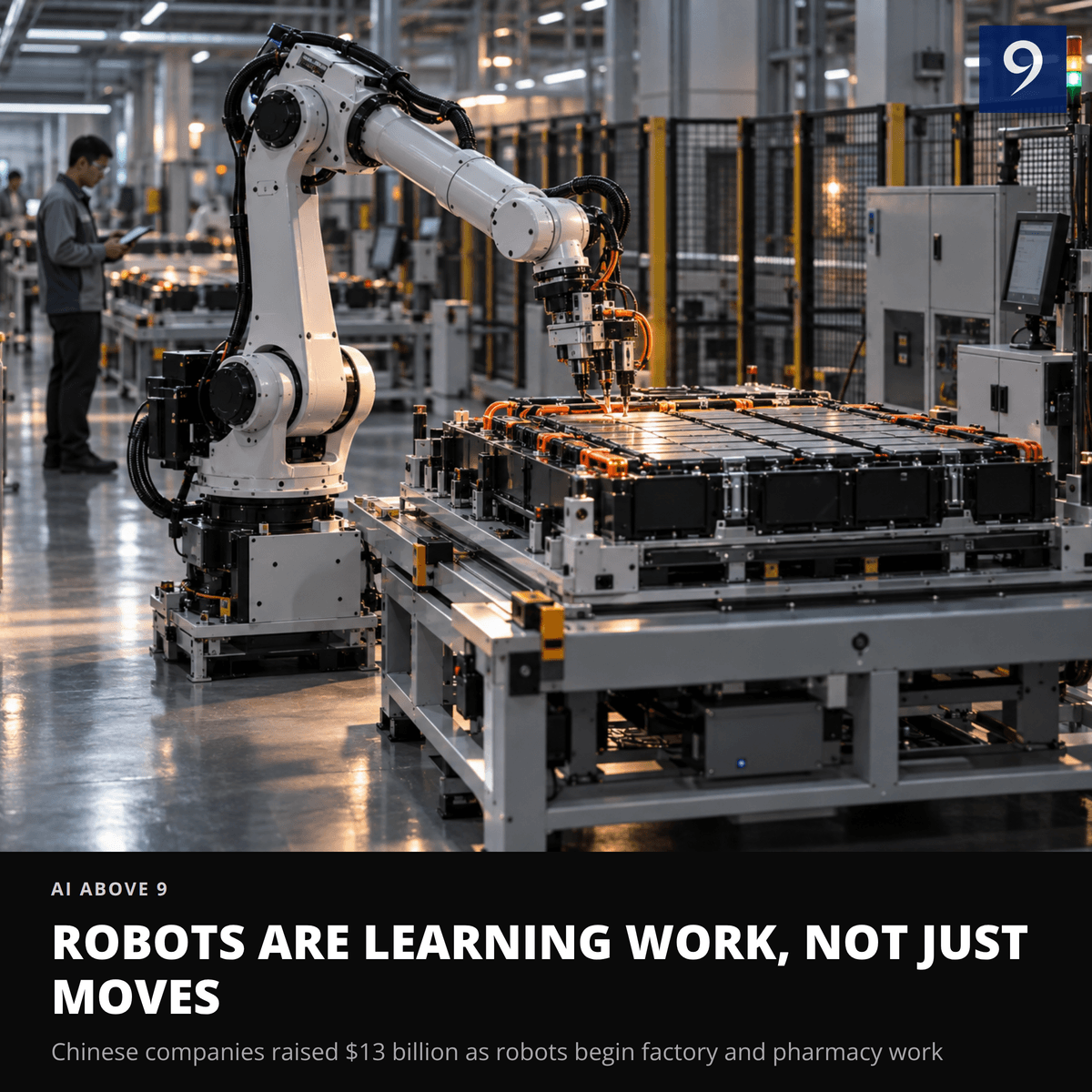
Robotics is moving beyond machines that repeat programmed moves. The goal now is machines that can learn unfamiliar work.
In China, companies building this kind of robot AI raised about $13 billion. That was in the first half of 2026, according to ITjuzi data.
Some robots are already being put to work on specific tasks. At a CATL plant, Spirit AI robots connect flexible wires during battery testing. Robbyant says its robots handle orders in two Shanghai pharmacies. Staff still check the medicines before dispatch.
That matters because a robot that can adapt could do useful work beyond a carefully rehearsed demonstration. The ambition is not simply better movement. It is handling unfamiliar tasks and surroundings.
X Square’s research offers a glimpse of how: a robot learned handling skills from a video of a person, without engineers teaching it from scratch for each task. Think of a new hire learning by watching a colleague, rather than receiving a separate script for every motion.
If this proves reliable across more workplaces, companies could teach robots new jobs by showing them. But these examples are company-reported, not proof that robots can work independently across whole businesses.
That is a different ambition from building a robot to repeat one polished demonstration. Can robots keep learning when a job changes in the middle of a shift? That is the test this investment cannot answer by itself.