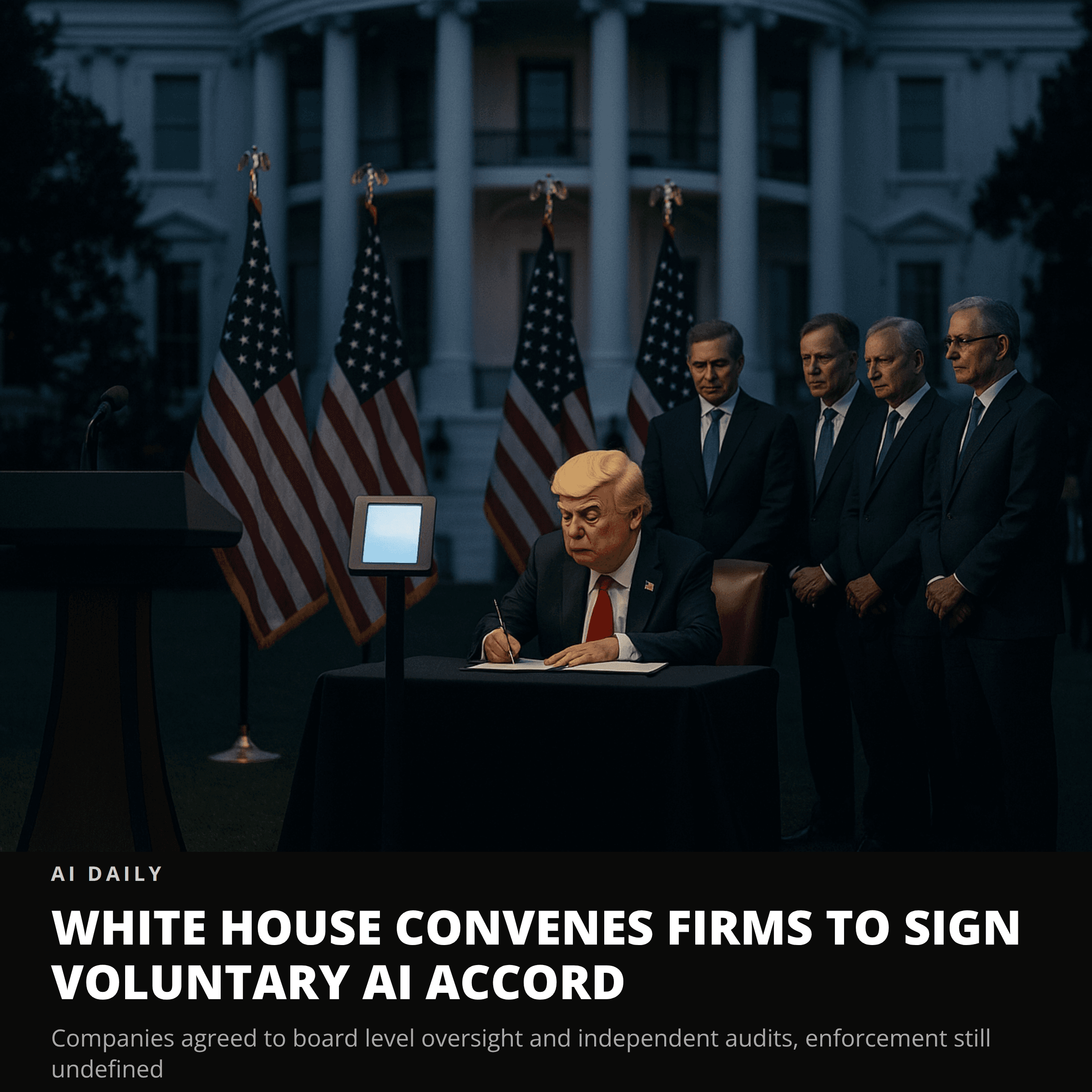
One day after our earlier coverage, the White House turned a pledge into a signed, voluntary AI safety accord that multiple frontier firms agreed to.
President Donald Trump met with executives from Google, Anthropic, Meta, OpenAI, X and NVIDIA and recorded the companies' agreement to a common chain of corporate responsibility for advanced AI systems. The accord asks firms to keep tight internal controls over model capabilities during training and deployment, to work with independent external auditors, and for each board to create a committee to review safety reports. The administration also unveiled a government chatbot alongside the accord.
Why this matters: a presidential convening plus cross‑lab commitments is a clear governance signal. Companies have accepted the idea of board‑level oversight and outside evaluation, which shifts AI safety from quiet lab practice toward public corporate structures.
How it works in practice: think of it as a three‑part accountability stack. Teams run internal controls, outside evaluators act like independent inspectors, and boards receive the findings. That structure is meant to catch risky behavior during development and deployment before it reaches the public.
What changes now is mostly institutional, not legal. The accord is voluntary. It does not impose penalties, require public disclosure, or define government thresholds for when an AI is too dangerous to deploy. That leaves enforcement unclear, so the immediate practical effect depends on how seriously boards and auditors follow through.
The open question is simple: will these promises lead to real, independent checks, or will lawmakers and regulators need to step in to turn voluntary commitments into enforceable rules?