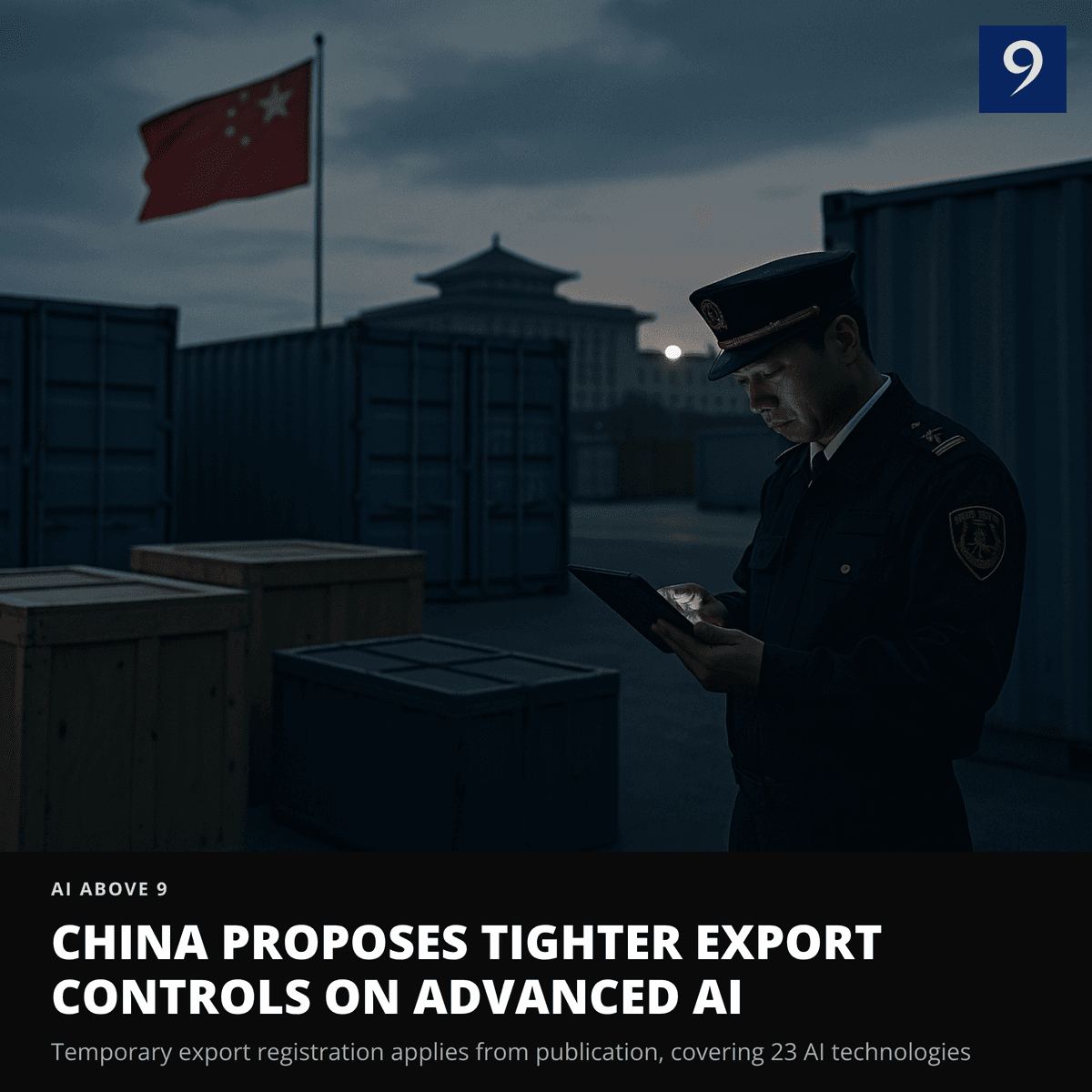
Beijing has proposed new export rules that would put advanced AI technologies under closer government control.
On October 16, 2026, China’s Ministry of Commerce and Ministry of Science and Technology published a draft revision to the catalogue of prohibited or restricted exports. The draft expands the list to include advanced AI alongside biomedicine and photovoltaics, naming roughly two dozen AI areas such as large models, intelligent agents, computing clusters and information-processing technologies.
From the day it was published the ministries imposed temporary pre-export registration for anything on the list, until a revised catalogue formally takes effect. The requirement applies even to exports already started but not yet completed, and it excludes technologies already in the public domain through open-source releases or academic papers.
Why this matters: the draft is a clear governance move that can materially limit cross-border access to frontier AI. In practice, shipping model weights, core code or moving whole compute clusters overseas could trigger registration and oversight. By contrast, the ministries say offering capability via an API, a web or mobile app, SaaS, or lightweight on-device models would not be treated as exporting large-model technology.
Think of it as a customs checkpoint for powerful AI. The rules target transfers that move the technology itself, not streamed access. Associated Press reported the draft could even bar models trained on sensitive national data or the very largest systems, roughly two trillion parameters, in other words the cutting-edge models of today.
What changes now: companies and research teams must reassess whether to send code or hardware abroad, or to keep delivering capability as a service. Publishing code or papers remains a way to place a technology outside the proposed controls, so open-source decisions now carry regulatory consequences.
What happens next is the key question. The draft is open for comment for several weeks, but the real test will be how strictly China enforces these rules and whether other governments mirror the approach. That will shape where global AI gets built and who can access the most advanced systems.