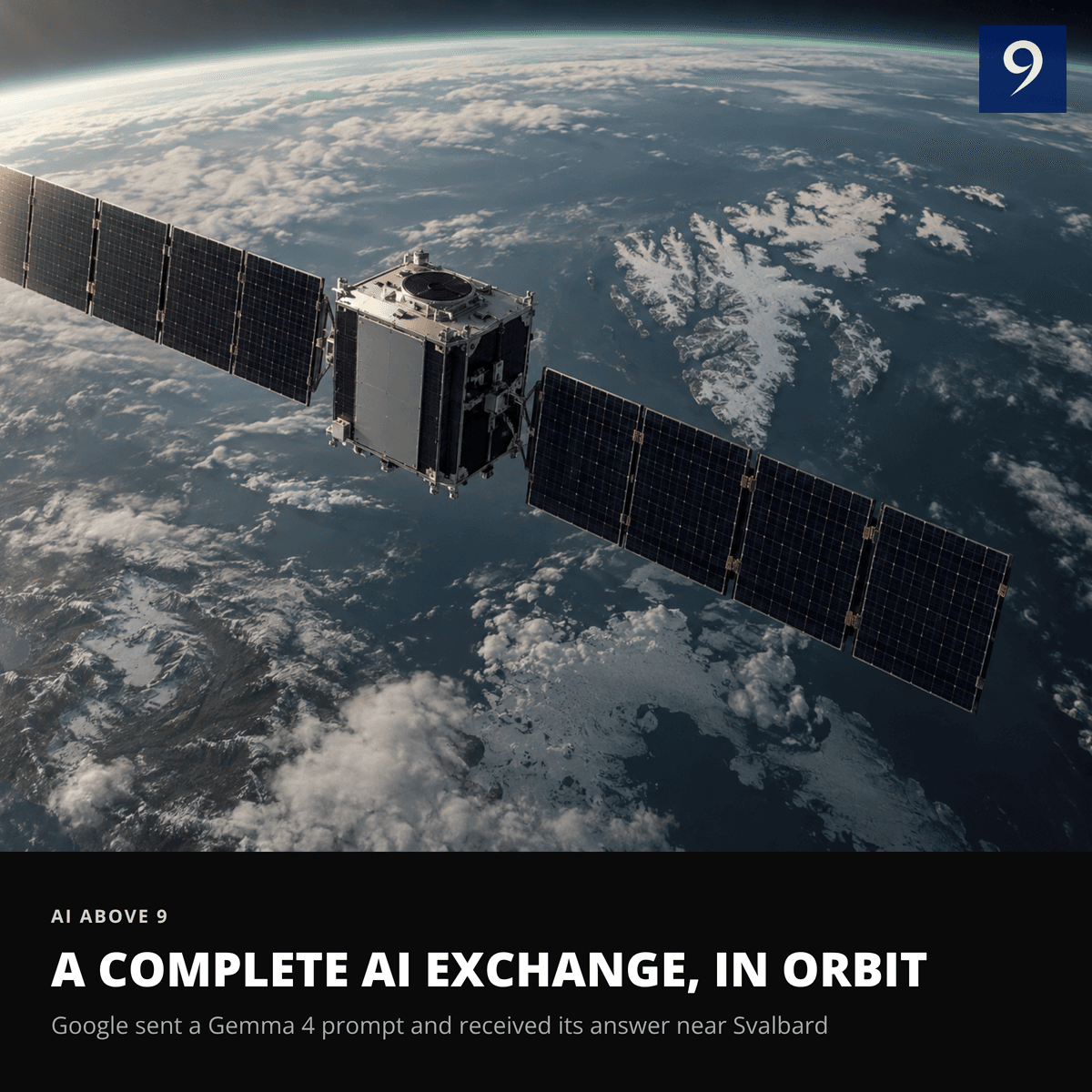
An AI model has now taken a question from Earth, answered it in orbit, and sent the answer back.
Google launched its Project Suncatcher prototype on October 1. The satellite powered up an onboard, data-center-class AI chip and ran early AI tests.
Then came a complete exchange. Google sent a prompt to Gemma 4, its open AI model, aboard the satellite. The answer came back during a ground-station pass near Svalbard, Norway. Google says it is the first response generated by a data-center-class chip in orbit.
The key milestone is not simply that the hardware switched on. The satellite completed the whole job: receiving a prompt, generating an answer, and returning it to Earth.
Think of it like sending a question to a remote computer. The difference is that the computer and AI model are aboard a satellite, rather than in a ground-based data center.
This gives Google a working starting point for testing AI compute in space. But one successful exchange does not prove the system can operate reliably over time. Google says it still needs to test how the chip handles heat and radiation in orbit.
The next step is connecting satellites. The bigger question is whether a successful test like this can grow into a dependable network of computers in space.