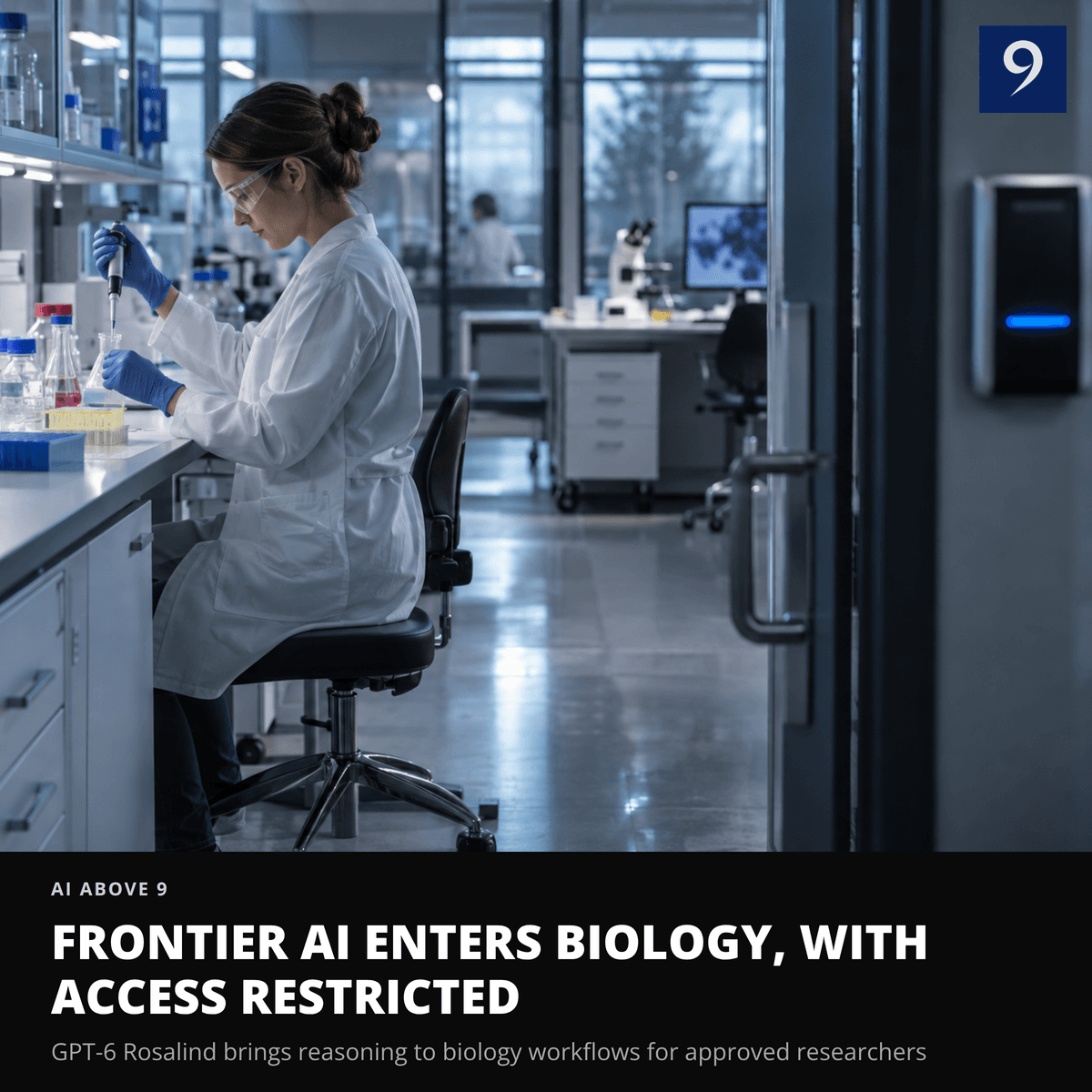
Frontier AI is moving into life-sciences research, but access is becoming part of the product. The question is not only what a model can help researchers do, but who is allowed to use it.
OpenAI’s GPT-6 Rosalind Research brings GPT-6 reasoning to multistep work in biology, drug discovery and translational medicine. Approved research customers can use it through OpenAI Work, Codex or the API, but not the Chat tab.
OpenAI says Rosalind uses the same underlying AI as GPT-6 Astra, its flagship reasoning model. The change is where and how that model can be used, not a new set of model foundations.
That matters because biology questions can have two sides. A question that helps researchers understand a disease could also be misused. OpenAI says Rosalind is designed to answer more legitimate research questions, including some with both helpful and harmful uses, while still refusing requests to support biological weapons.
To manage that risk, OpenAI limits access to approved research users, sets boundaries on harmful biological and cyber assistance, and says it will monitor use and enforce its rules. Its safety framework rates the model’s biological and chemical capability High, below Critical, and its cybersecurity capability Critical. Those are risk assessments, not guarantees that every harmful use will be caught.
For approved teams, the model is available inside research and development workflows. But it is not something anyone can open in Chat and try: enterprise access begins with an administrator preview that is off by default. Frontier AI is becoming more available to specialist researchers, while the front door stays deliberately narrow.
The real test is whether a model can become more useful for legitimate research without also becoming more useful to someone with harmful intent. That is what this rollout now has to prove.