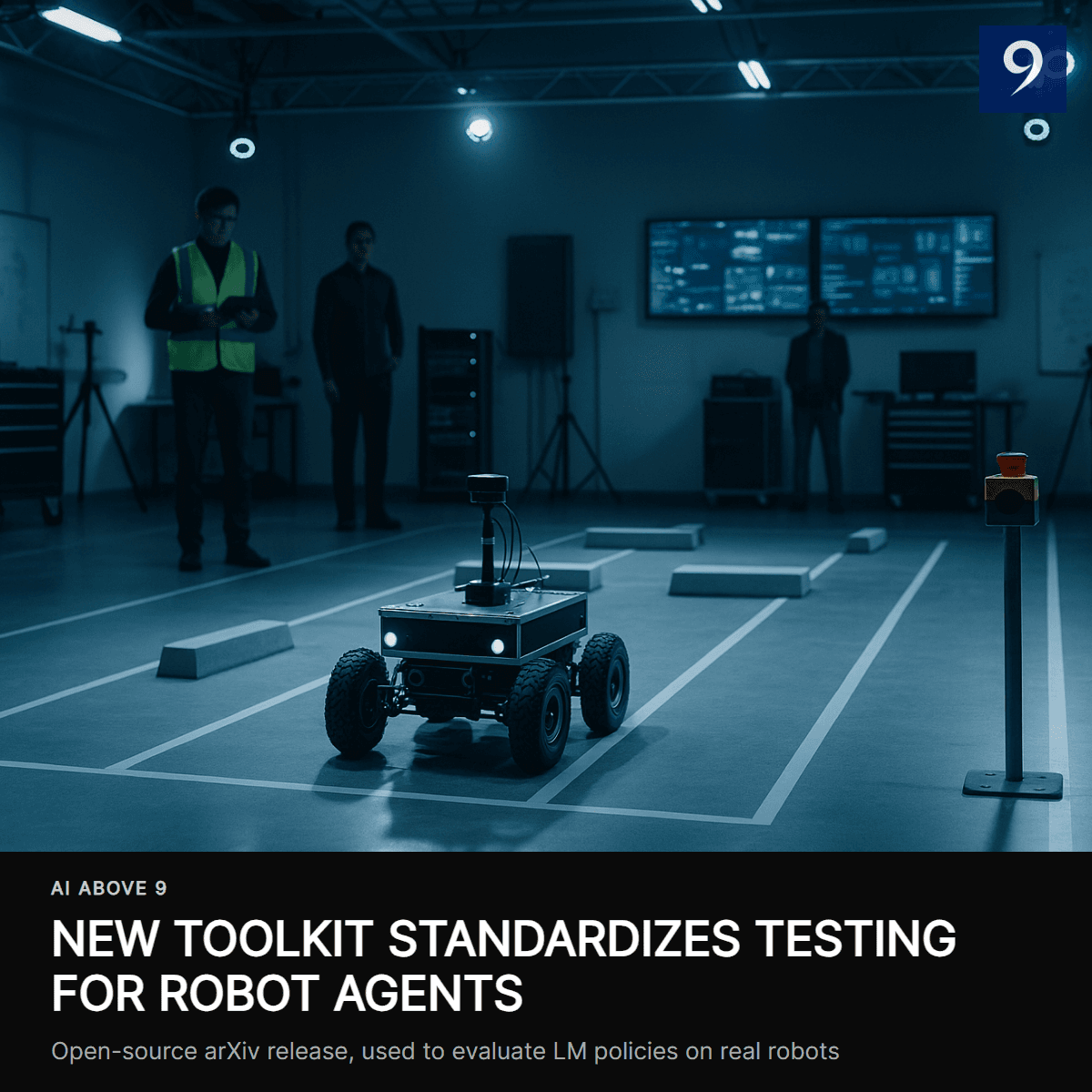
A toolkit just landed that makes it practical to test how language models behave when they control real robots.
It is called Inspect Robots, and the authors published the design and code on arXiv as an open source framework for evaluating embodied agents. The project supplies reusable building blocks to describe physical tests and the automation to set up, run, and terminate experiments without recreating the whole lab workflow each time.
The paper also uses the framework to evaluate six policies based on frontier language models running on actual robot hardware, showing the system works beyond simulation.
Why this matters is simple: until now there was no common, repeatable way to compare how different models act in the physical world. Inspect Robots turns anecdote and ad hoc demos into experiments researchers can share, rerun, and audit.
Think of it as a standardized racetrack and timing system for robot behavior. You define a scenario, plug in a control policy, and the framework drives the robot, records what happens, and stops the run if something goes wrong. That structure makes results comparable across teams.
The community response is already strong. The authors report nearly 100,000 downloads in three months, which suggests labs and developers are adopting these tools fast. That uptake matters because it makes safety and capability testing visible, measurable, and therefore actionable.
A practical caveat: running full physical evaluations still requires robots, sensors, and lab infrastructure. The blueprints are public, but not every startup or researcher can reproduce every hardware test immediately.
The open question now is whether Inspect Robots will produce shared benchmarks and clearer accountability, or whether testing will fragment into many incompatible suites. Watching which teams publish reproducible robot evaluations is the next place to look.