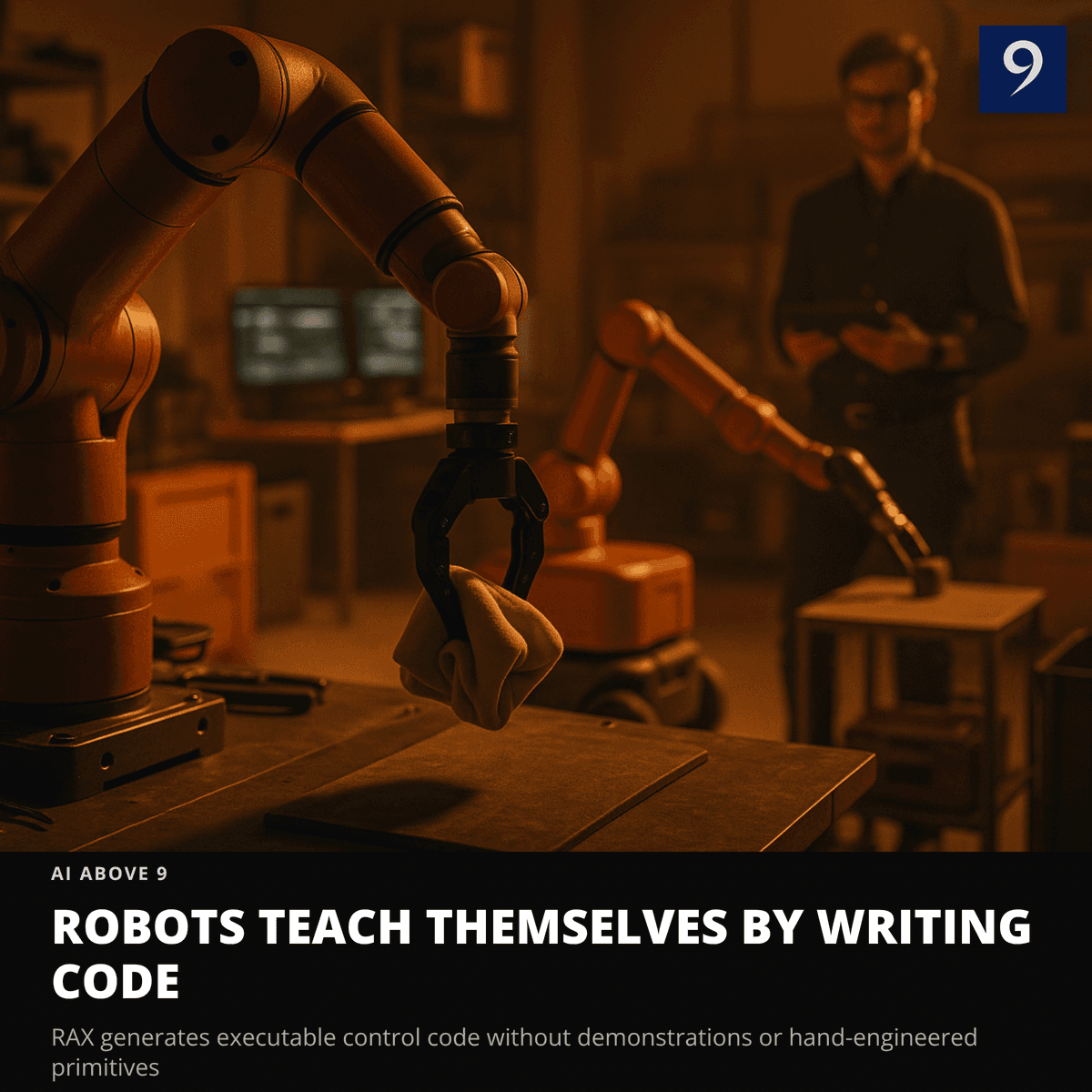
Robots can now teach themselves new physical skills by writing and running their own control programs.
That is the core claim of RAX, a Robot Agent eXploration framework that uses a general-purpose coding agent to generate executable robot-control code on the fly, without demonstration data, hand-built action primitives, or value-function guidance.
The team tested RAX in simulation and on real hardware across different robot bodies. Their report says physical systems learned memory-dependent routines, fine and articulated manipulation, handling deformable objects, and long-horizon mobile-manipulation tasks. RAX is open source and new robot types can be added through its APIs, so teams do not need to collect teleoperated data or train a separate policy to get started.
Why this matters: until now, getting robots to do complex, long tasks typically meant either collecting lots of demonstrations, engineering specific actions, or running expensive policy-training. RAX replaces those steps with a loop where an AI writes code, the robot tries it, and the results steer the next code edit. That changes how quickly a lab can go from idea to tested behavior.
Think of it as a developer on call for the robot: the AI writes a small routine, the robot runs it, observes what happens, and the AI revises the program. It is simple to picture and true to how the system explores.
This does not mean anyone can run it on a laptop. Real hardware, safety checks, and engineering effort remain necessary. The open question is whether the wider community can reproduce these physical results and make this approach robust and safe at scale.